Eczema in Skin of Color: Diagnosis, Dark Spots, and a Care Routine That Works

Almost every eczema photo you have ever seen was taken on white skin. Open a textbook, a pamphlet, or the first page of image results, and the rash is pink or angry red on a pale background. If your skin is brown or black, that picture is not just unhelpful. It is actively misleading, because the single feature everyone is taught to look for is the one feature your skin may not show.
Eczema is more common in Black children than in white children, and more likely to be severe when it appears. It is also more likely to be missed, downplayed, or mistaken for something else entirely. That gap is not a mystery. It comes from a diagnostic habit built around redness, and from clinicians who have simply seen fewer examples on melanin-rich skin.
What eczema actually looks like on brown and black skin
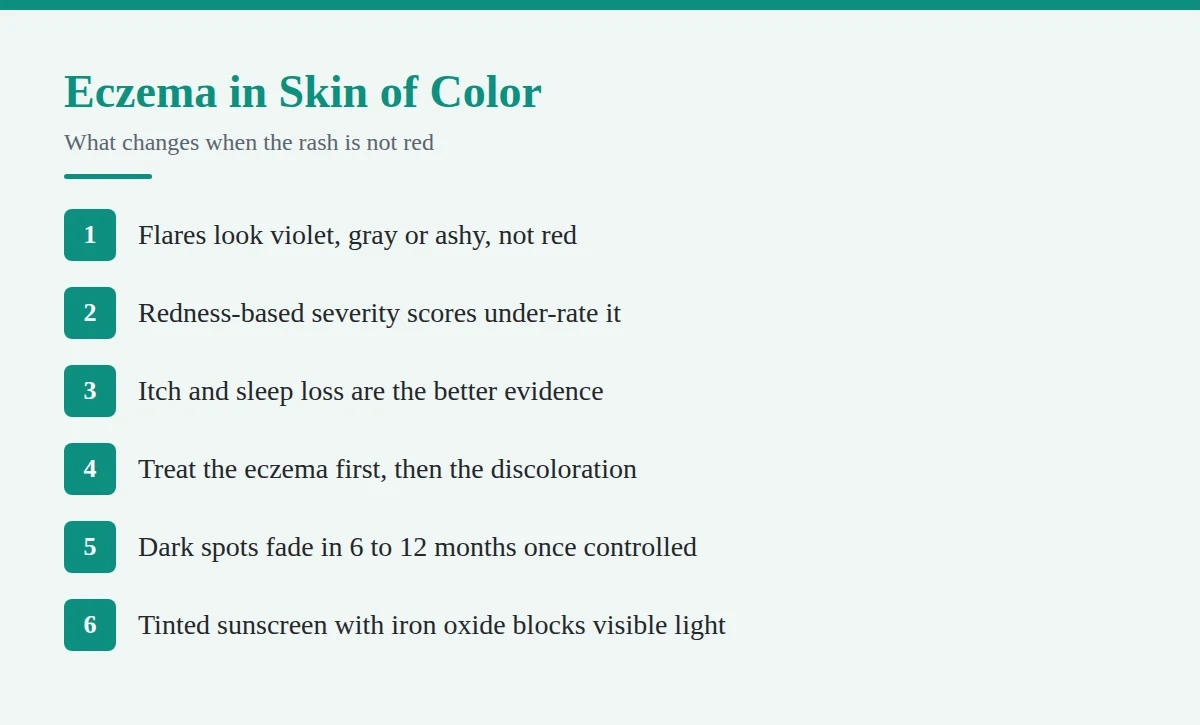
Redness is inflammation seen through skin. In deeply pigmented skin, melanin sits above the blood vessels and filters what reaches your eye, so the same inflammation that reads as bright red on pale skin reads as something quieter and darker.
What you are more likely to see:
- Violet, plum, or deep brown patches rather than pink or red
- Gray or ashy patches, especially where the skin is dry and flaking
- Darker brown skin that simply looks “off” compared with the surrounding area, with the border easier to feel than to see
- Small raised bumps around hair follicles, a papular or follicular pattern that is much more common in skin of color and is often mistaken for acne, heat rash, or keratosis pilaris
- Thickened, leathery, exaggerated skin lines from long-term scratching, called lichenification, which tends to develop earlier and more prominently
- Firm, intensely itchy nodules on the arms and legs, known as prurigo nodularis
The distribution can differ too. The classic teaching is that eczema settles in the creases of elbows and knees. In skin of color it appears more often on the extensor surfaces, the outside of the elbows and the front of the knees, which can send a clinician looking for psoriasis instead.
Here is the piece that matters most: if you cannot see redness, you have to trust the other symptoms. Itch, dryness, sleep loss, and thickened skin are the disease. Colour is only how it announces itself.
Why it gets missed, and why “mild” is often wrong
Two things go wrong at once.
The first is the image problem. Medical training materials have historically shown a narrow range of skin tones, so a clinician can complete a full education having rarely seen atopic dermatitis on dark skin. Meanwhile, dry, flaking skin gets waved off as “just ashy,” scalp eczema gets called dandruff, and hyperpigmentation gets described as an old mark when the eczema underneath is still active and still inflaming the skin.
The second is that the measuring tools are built on redness. The standard severity scores your dermatologist uses, SCORAD and EASI, both assign points for erythema. When erythema is hard to see, the score comes out lower than the disease deserves, and a person with genuinely moderate to severe eczema is recorded as mild. That single number can decide whether you are offered a stronger prescription, a referral, or a biologic.
Which is why what you say in the room carries more weight than usual. Report the itch, the nights you lose, the school or work you miss. Those are not softer evidence. On melanin-rich skin, they are frequently the more accurate evidence.
Dark spots and light spots: what the flare leaves behind
For many people, the marks outlast the rash by months, and the marks are the part that hurts to look at in the mirror.
Post-inflammatory hyperpigmentation (dark spots). Inflammation stimulates pigment cells to overproduce melanin, so a healed patch of eczema leaves a brown, or sometimes slate gray, footprint. This is one of the most common reasons people with darker skin tones see a dermatologist at all. Timing is worth knowing: a spot a few shades darker than your natural tone usually fades within six to twelve months once the eczema is controlled. When the pigment sits deeper in the skin, which tends to look slate blue or gray rather than brown, fading can take years.
Post-inflammatory hypopigmentation (light spots). The same inflammation can go the other way and switch pigment production down, leaving pale patches. In children this often shows up as pityriasis alba, faint scaly light patches on the cheeks and upper arms. These are not scars and not bleach damage. The pigment cells are still there, subdued rather than destroyed, and colour usually returns as the skin heals.
The distinction that matters clinically is vitiligo, where pigment cells are actually destroyed and the patches are typically sharply bordered and stark white rather than softly faded. That needs a dermatologist to sort out, not a guess in the bathroom mirror.
How to actually fade the marks
The order of operations is not intuitive, and getting it backwards wastes months.
Treat the eczema first. Discoloration is downstream of inflammation. Chasing the spots while the eczema is still active is like mopping with the tap running, and every new flare deposits fresh pigment. If your flares keep returning, our flare playbook covers early recognition and a rescue routine that shortens each episode.
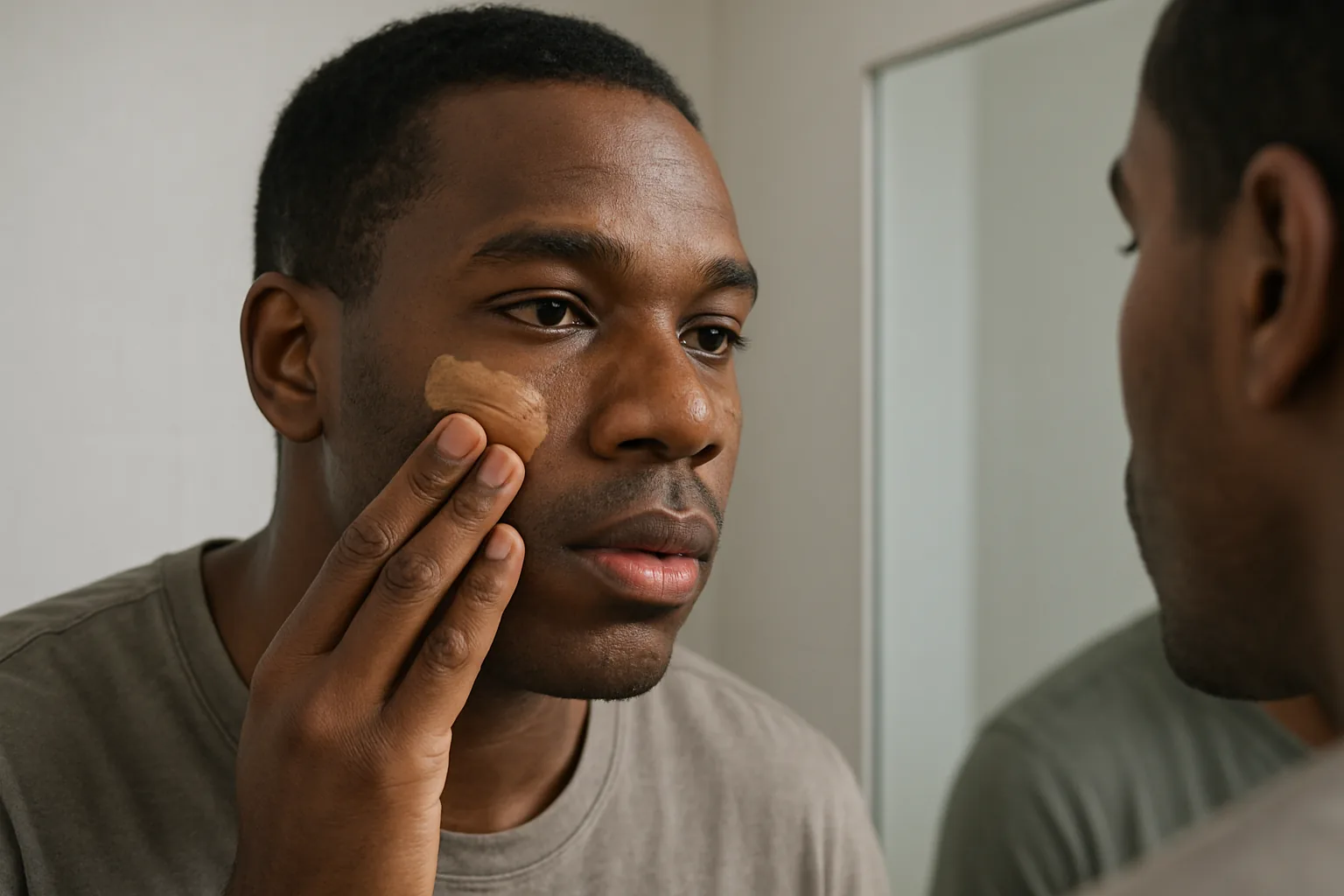
Use sunscreen, and make it tinted. This is the step people skip because of the persistent myth that darker skin does not need it. Sunlight drives pigment production, so unprotected sun turns a fading spot into a darker one, and can turn a light spot dark by prompting the skin to overcorrect. Look for tinted sunscreen containing iron oxide, listed among the inactive ingredients, because iron oxide blocks the visible light that ultraviolet filters alone do not. Aim for SPF 30 or higher, broad spectrum, water resistant, and a shade that actually blends instead of leaving a chalky cast.
Do not treat the spots yourself. Skin-lightening products sold outside pharmacy regulation are a genuine hazard: some contain mercury, some contain potent steroids that thin the skin and rebound worse, some contain hydroquinone at concentrations that cause a permanent blue-gray discoloration called ochronosis. In the United States, hydroquinone has been prescription-only since 2020 for exactly this reason. Prescription options exist, along with in-office procedures, but the right one depends entirely on why your skin is discolored, which is a diagnosis rather than a purchase.
Give it time. Pigment changes fade slowly by nature. Judge progress over months, not weeks, and photograph the same patch in the same light every few weeks so you can see the change that daily viewing hides.
A daily routine that fits melanin-rich skin
The fundamentals are the same for everyone. What changes is the friction.
- Short, warm showers. Five to ten minutes, not hot. Pat dry and leave the skin slightly damp.
- Moisturize within three minutes, while the skin is still damp, to seal water in. This is the soak-and-seal step, and it is the highest-value habit in the whole routine.
- Choose ceramide-rich creams and ointments over lotions. Ceramides help repair a barrier that, in skin of color, tends to lose water faster and hold fewer natural lipids. Ointments and thick creams outperform lotions on very dry skin.
- Manage the cast. Thick ointments can leave a visible gray or white film on darker skin, which is a real reason people quietly stop using them. Two workarounds: apply ointment at night and a well-absorbed ceramide cream during the day, or warm a small amount between your palms first and press it in rather than rubbing it on.
- Fragrance-free everything. Cleansers, laundry detergent, hand soap. Irritation itself triggers pigment.
- Reapply hand cream after every wash.
- Loose, breathable cotton rather than wool or tight synthetics.
Give any routine change a full two weeks before deciding it has failed.
Scalp and hair: where standard advice collides with real life
This is the part most eczema guides skip entirely, and it is where a lot of Black patients quietly give up on their treatment plan.
Scalp eczema in textured hair gets misread as dandruff, and the standard prescription (medicated shampoo several times a week) runs straight into the fact that dermatologists recommend washing Black hair roughly once a week or every other week, because frequent washing strips already fragile hair. Both pieces of advice are correct. They just need reconciling, and that is a conversation to have out loud with your dermatologist rather than choosing one and abandoning the other.

What usually works in practice:
- Apply medicated shampoo to the scalp only, not the lengths, and let it sit five to ten minutes before rinsing so it has contact time on wash day.
- Always follow with conditioner, concentrating on the ends, which are the oldest and most fragile part of the hair.
- Ask about scalp oils, foams, or solutions as an alternative vehicle. Steroid or non-steroid preparations formulated for the scalp can be used between washes without a full wash cycle.
- Do not have braids, cornrows, or weaves installed tightly. If it hurts while it is being styled, ask the stylist to stop and redo it. Pain means damage, and traction on an already inflamed scalp is a route to permanent hair loss.
- Be cautious with relaxers and heat. Chemical relaxers on eczema-broken scalp skin burn and sting for a reason. If you use them, a professional application, touch-ups no more often than every two to three months, and never over previously relaxed hair.
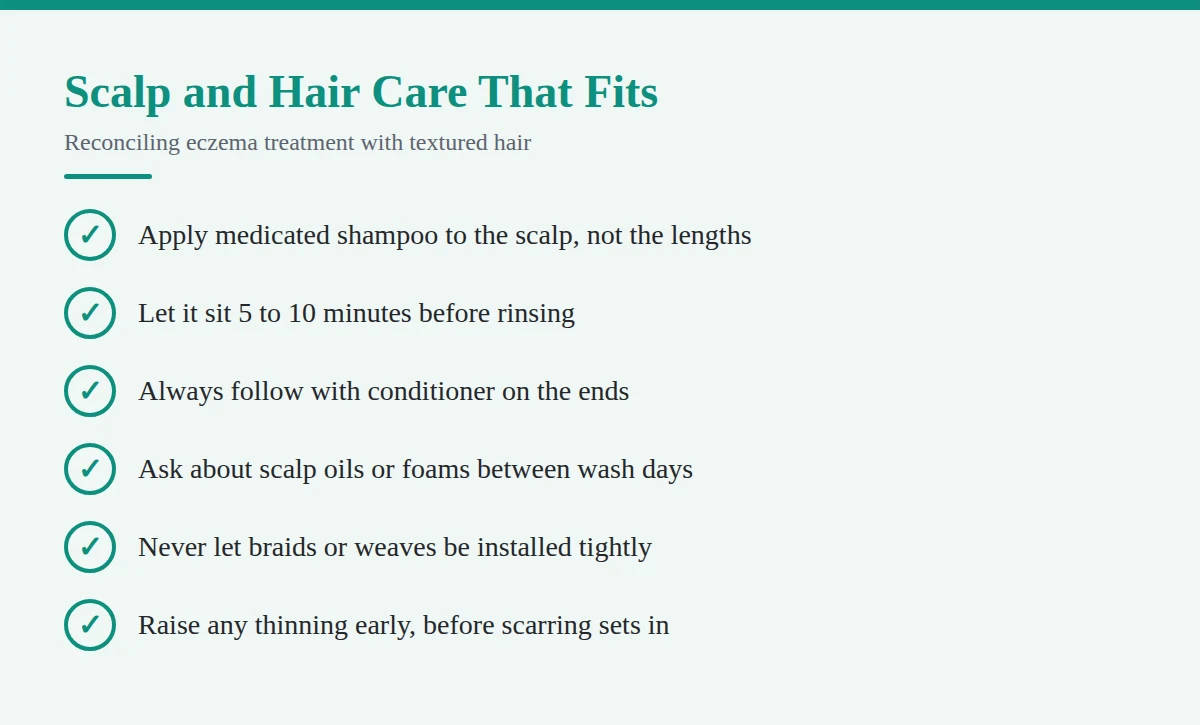
If you notice thinning, even slightly, raise it early. Hair loss is far more treatable at the beginning than after scarring sets in.
Getting taken seriously in the appointment
Four signs your concerns are not being addressed: your worries get minimized, your disease is labelled mild when it does not feel mild, the plan is impossible to fit into your actual hair and skin routine, or the visit covers only the rash and never the itch, sleep, or pigmentation.
Walking in prepared changes the conversation. Bring a written list of everything you have tried, including drugstore products and home remedies. Bring photos taken in consistent daylight, since flares rarely cooperate with appointment times. Name the discoloration explicitly as a concern you want treated, because it is often assumed to be cosmetic and skipped. And ask directly whether pigment change is being counted in your severity assessment.
You can also filter for a dermatologist whose practice focus is skin of color through the American Academy of Dermatology’s Find a Dermatologist tool. If your current clinician is not engaging, a second opinion is reasonable and not rude.
For families, the same logic starts young. Black children are disproportionately affected and disproportionately under-treated, so early control matters more, not less. Our parent’s guide to baby and childhood eczema covers the daily routine by age, and because eczema in infancy raises food allergy risk, our guide to early allergen introduction is worth reading before the first birthday.
The bottom line
Eczema on brown and black skin is the same disease with a different signature. It shows up violet, gray, ashy or simply darker instead of red. It leaves marks that can outlast the flare by a year. It responds to the same treatments, provided somebody recognizes it and rates its severity honestly.
If you have been told your dry, itchy skin is “just ashy,” or that your dark spots will fade on their own while the itch continues, that is worth a second look. Persistent itch is not a cosmetic complaint, and if you are still working out which condition you are dealing with, our guide to the seven types of eczema is a good place to start.
Every person’s skin behaves differently, and none of this replaces an examination. A board-certified dermatologist, ideally one experienced in treating skin of color, can confirm what you have, treat the inflammation driving the discoloration, and build a plan that fits your hair and your life rather than fighting both.
Further reading (sources)
- American Academy of Dermatology on fading dark spots in darker skin tones
- American Academy of Dermatology for treating light spots on brown or black skin
- Everyday Health with advice on advocating for better atopic dermatitis care with darker skin
- National Eczema Association discussing how eczema appears and is managed in skin of color
- National Eczema Association for atopic dermatitis, including how it presents on different skin tones