SCORAD, EASI and POEM: How Eczema Severity Is Scored and How to Track Your Own
You will meet these acronyms whether or not anyone explains them. A dermatologist writes “EASI 18” in your notes. A press release announces a “95% SCORAD reduction in eight weeks.” An insurer wants proof of moderate-to-severe disease before it will fund a biologic. A trial result says 60 percent of patients “achieved EASI-75,” and it sounds like most people got better than they really did.
These are eczema severity scores, and they are not mysterious once you see what each one counts. More usefully, three of them are things you can track at home, which changes what a fifteen-minute appointment can achieve.
Why eczema needs a score at all
There is no blood test for atopic dermatitis. No biopsy result comes back saying “moderate.” Severity has to be assembled from what a clinician can see, what you can feel, and how much of your life the disease is eating.
That makes eczema unusual among chronic conditions, and it creates a practical problem. If a drug trial in Sweden and a clinic in Ohio both want to say “this got better,” they need the same yardstick. Scoring systems are that yardstick. They exist mostly for research and access decisions, not for you, which is exactly why nobody talks you through them.
They fall into two camps. Clinician-reported scores (SCORAD, EASI, IGA) measure what a trained observer sees on your skin. Patient-reported scores (POEM, DLQI) measure what you experience. The two often disagree, and that gap is one of the most useful things in this article.
SCORAD: extent, intensity, and how you feel
SCORAD, the Scoring Atopic Dermatitis index, was built by the European Task Force on Atopic Dermatitis and is the score you will most often see in European papers. It has three parts.
A is extent. The clinician estimates what percentage of your body surface is affected, using the rule of nines (each arm 9 percent, the head 9 percent, each leg 18 percent, and so on).
B is intensity. Six signs are graded 0 to 3 on a representative patch: redness, swelling, oozing or crusting, scratch marks, thickened leathery skin (lichenification), and dryness of unaffected skin.
C is you. Two 10-point scales, one for itch over the last three days and one for sleep loss.
The parts combine as A/5 + 7B/2 + C, giving a maximum of 103. Under 25 is mild, 25 to 50 is moderate, and above 50 is severe. What matters is that roughly a fifth of the total comes from your own itch and sleep ratings, which is why you may be asked to mark two lines on a page before the exam. There is also an “objective SCORAD” that drops part C entirely, so a paper quoting objective SCORAD is describing skin alone.
EASI: the trial workhorse
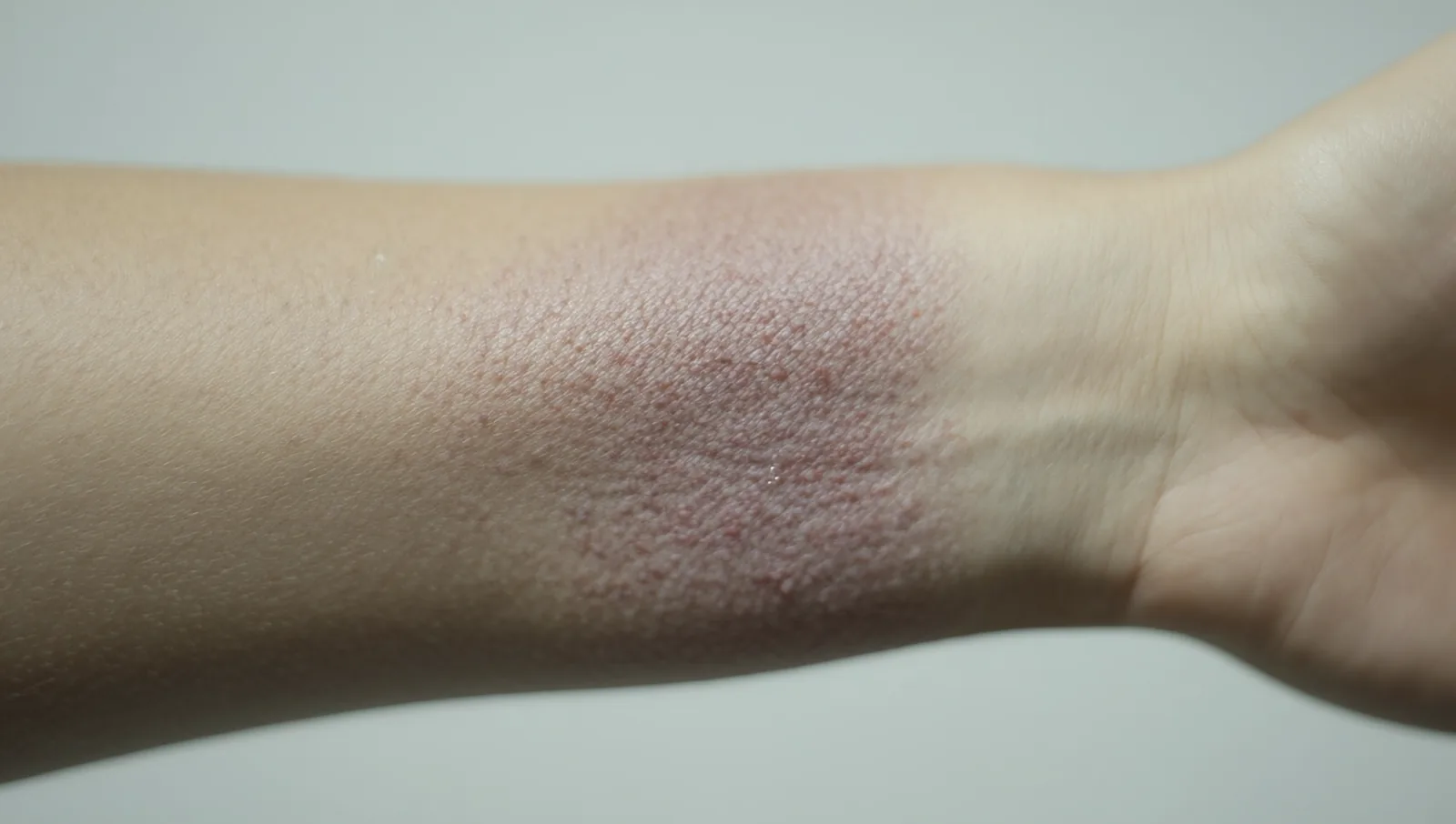
The Eczema Area and Severity Index is the score regulators and drug trials lean on hardest. The body is split into four regions (head and neck, trunk, upper limbs, lower limbs). In each region, four signs are graded 0 to 3: redness, thickness or swelling, scratch marks, and lichenification. Those are multiplied by an area score and by a regional weighting, because a leg is worth more surface than a face. The total runs 0 to 72.
Two things about EASI are worth knowing. First, it contains no itch and no sleep. It is a pure picture of skin. Second, and this is the one that misleads people, EASI-75 does not mean 75 percent clear. It means a 75 percent improvement from where that person started. Someone who began at EASI 32 and improved to EASI 8 has hit EASI-75 while still having real, visible eczema. When a headline says a drug achieved EASI-75 in half of patients, read it as “half the group cut their score by three-quarters,” not “half the group cleared.”
IGA: the one-number snapshot
The Investigator’s Global Assessment is the simplest of the set: a single 0 to 4 rating of clear, almost clear, mild, moderate or severe, made in one look. It is quick, which is why it turns up in clinic notes and on insurance forms. Its coarseness is the trade-off. Trials usually pair it with EASI and define success as reaching 0 or 1 with at least a two-grade improvement.
POEM: your seven questions
The Patient Oriented Eczema Measure is the one to actually learn, because you complete it yourself and it takes about a minute. Developed at the University of Nottingham, it asks how many days in the last week you had each of seven symptoms: itching, sleep disturbance, bleeding, weeping or oozing, cracking, flaking, and dryness or roughness.
Each answer scores 0 (no days) to 4 (every day), for a total out of 28:
| POEM score | Band |
|---|---|
| 0 to 2 | Clear or almost clear |
| 3 to 7 | Mild |
| 8 to 16 | Moderate |
| 17 to 24 | Severe |
| 25 to 28 | Very severe |
A change of about 3 points is considered meaningful rather than noise. POEM is free to use, valid for adults and children, and it is the patient-symptom measure recommended by the international HOME initiative, the group that decided which outcomes eczema studies should all report. If you bring one number to an appointment, bring this one.
DLQI: the part that is not skin
The Dermatology Life Quality Index is ten questions about the past week covering embarrassment, clothing choices, social life, sport, work or study, relationships, and how much treatment itself gets in the way. It scores 0 to 30, where 11 or above signals a very large effect on life. Children have their own version (CDLQI), and infants an equivalent completed by parents.
DLQI matters because it captures the burden that skin scores miss entirely, and because funding decisions in some health systems hinge on it.
Where the scores and your life disagree
This is the honest part. The measures are useful, and they are also systematically blind in a few places.
Small area, huge impact. Hand eczema can score low on EASI (hands are a fraction of body surface) while ending a career in nursing, hairdressing or catering. The same goes for eyelids and genital skin. A low score does not mean a low problem.
Redness is scored badly on brown and black skin. Erythema is a founding component of both SCORAD and EASI, and on deeper skin tones inflammation reads as violet, grey, or darker brown rather than red. Clinicians who trained mostly on white skin routinely under-score it, which means severity is underestimated in exactly the patients whose eczema tends to be more severe. If you have skin of colour, say plainly how the skin feels rather than relying on how it grades.
Nothing scores exhaustion well. Sleep loss earns two points of 103 in SCORAD and appears in one of seven POEM items. Anyone who has been awake scratching since 3 a.m. knows the weighting is generous to the disease. Our piece on sleep and eczema covers why that loop matters more than the numbers suggest.
Headline percentages need a squint. A recent open-label pilot in children reported a 95 percent SCORAD reduction over eight weeks, which sounds extraordinary. Open-label means everybody knew what they were taking, there was no control group, and mild-to-moderate eczema improves substantially on attentive routine care alone. Compare that with a network meta-analysis of 32 randomised trials in children, which ranked dupilumab and tralokinumab at the top for SCORAD improvement precisely because randomisation strips out that effect. The design matters more than the number.
Building a tracking routine that pays off
Clinic scores are snapshots taken on the days you happen to be seen, which are rarely your worst days. Your own record fills the gaps. Four habits are enough.
Weekly POEM. Same day each week, one minute. Write the number down. A run of 14, 16, 15, 17 tells a story that “it’s been bad lately” does not.
A daily line, not a diary. Itch 0 to 10, sleep quality 0 to 10, and what you applied. Two numbers and a word. Long journals get abandoned by week three.

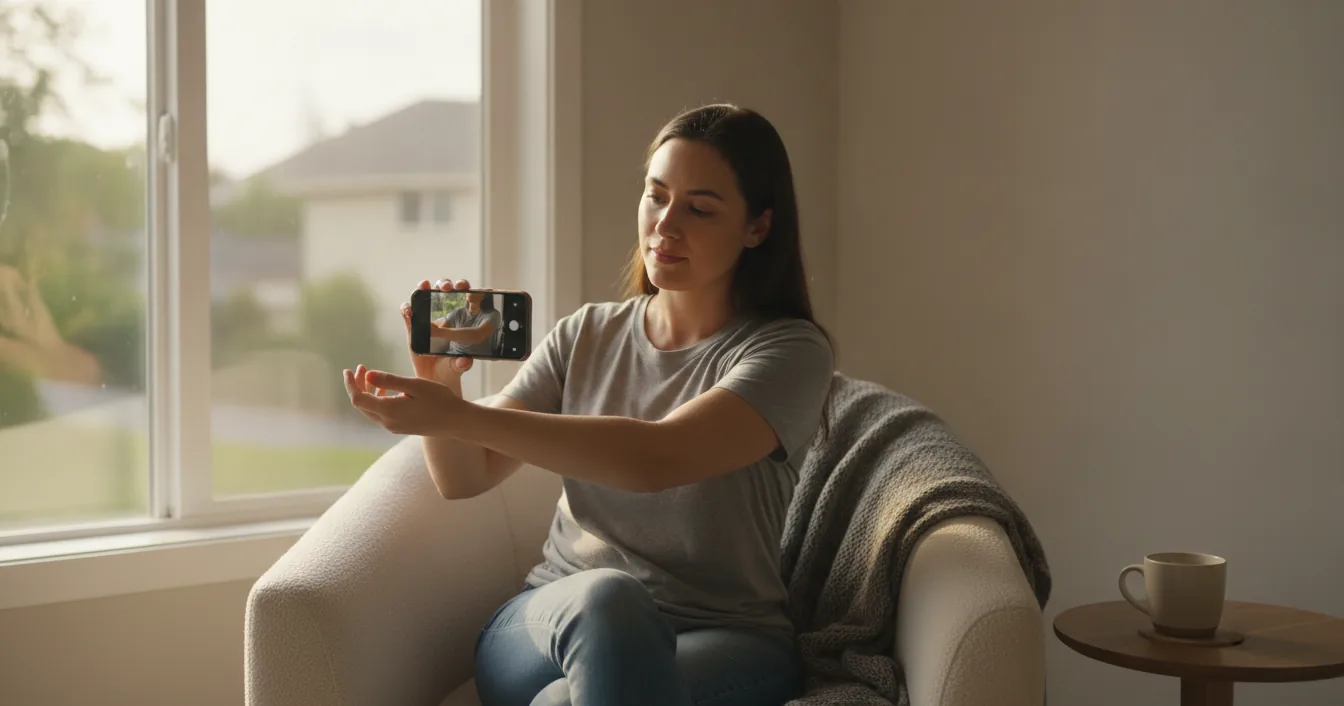
Monthly photos, controlled. Same spot, same distance, same time of day, near a window with the flash off. Consistent lighting is the entire point, because skin colour shifts wildly under different bulbs. Photograph one or two representative areas rather than everything.
Flare and trigger notes. Date a flare started, what changed in the preceding week (new detergent, illness, heat, stress, a missed week of moisturiser), and what settled it. Patterns emerge over months, not days.
There is a good reason this pays off beyond record-keeping. Researchers modelling eczema as a nonlinear dynamical system found that flares behave like a system tipping between two stable states, and that the intervention needed to push it back into remission is smaller when it is applied early and maintained steadily. That is the mathematical version of what dermatologists mean by proactive treatment, and it only works if you can see a flare building. Tracking is what makes a flare visible early.
Making the appointment count
Bring three things: your POEM trend, your photo set, and one specific question. “My POEM has sat between 14 and 18 since May; here are photos from three months, and my current treatment is X” gives a dermatologist more useful information in twenty seconds than a description of today’s skin.

Ask directly which score they use and what your number is. Ask what number would change the plan. If you are heading toward biologics or JAK inhibitors, documented severity is often what unlocks access, and a scattered account of a bad year is weaker evidence than a chart. Our guide to how eczema is diagnosed and treated covers what else the visit should include.
Two cautions. Scores measure eczema, not infection: skin that turns rapidly warmer, weepier, crusted yellow, or feverish needs same-day care, and clustered punched-out sores near a cold sore may be eczema herpeticum, which is an emergency rather than a severity change. And numbers do not diagnose. Confirming which of the types of eczema you have, and building a treatment plan around it, is work for a board-certified dermatologist or allergist.
Used well, these scores stop being jargon on a chart and become a shared language. That is the whole point of them.
Further reading (sources)
- National Eczema Association on how severity is measured and what the tools ask
- Centre of Evidence Based Dermatology, University of Nottingham for the POEM questionnaire and its scoring bands
- HOME Initiative with the core outcome set eczema studies are asked to report
- DermNet on the SCORAD and EASI scoring instruments in practice
- Frontiers in Immunology for a network meta-analysis ranking pediatric treatments by SCORAD and EASI
- AIP Publishing covering the nonlinear-dynamics model of flares and minimal effective dosing
- Everyday Health on moving from reactive flare-fixing to proactive control