Early Allergen Introduction for Babies With Eczema: Can Feeding Prevent Food Allergy?
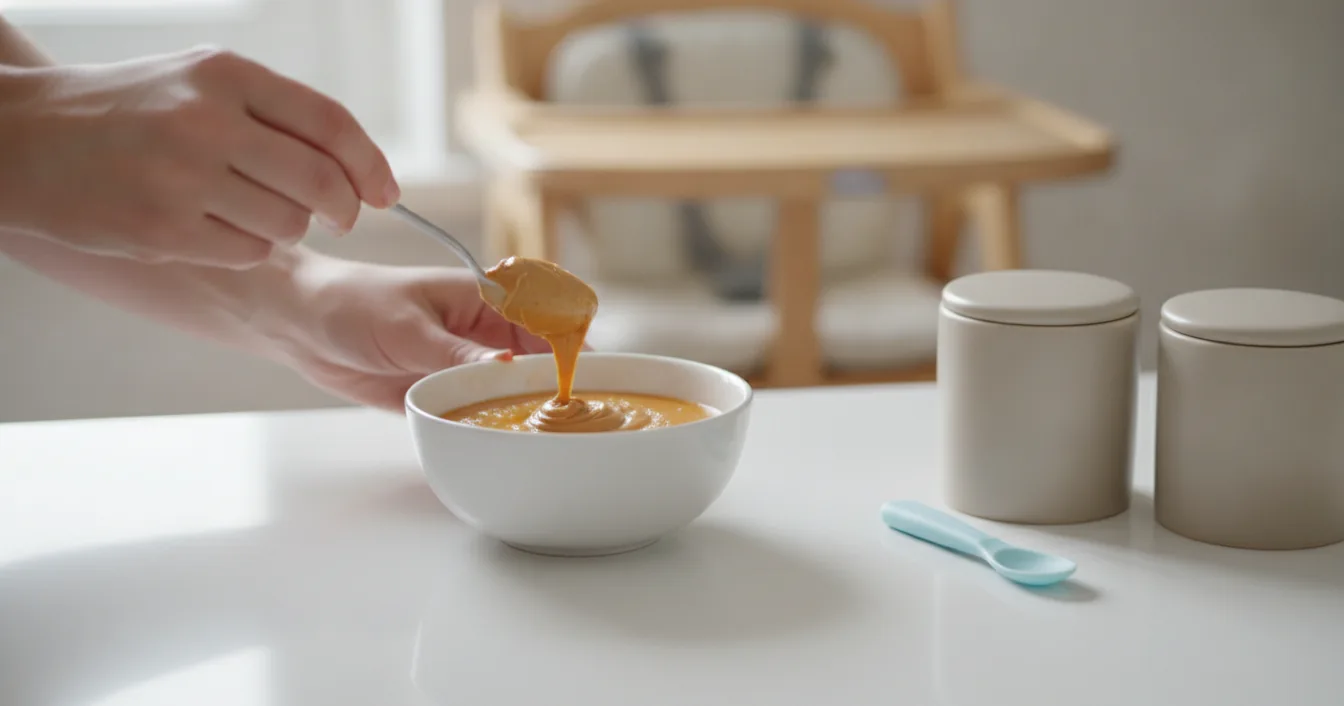
If your baby has eczema and you are working up the nerve to offer their first taste of peanut butter, you have probably noticed something confusing. Your own parents were told to keep peanuts away from young children. Some websites still say it. And yet your pediatrician is telling you to start early, on purpose, before the first birthday.
That is not a mixed message. It is a reversal, and it happened because the old advice made things worse.
Why “wait and avoid” backfired
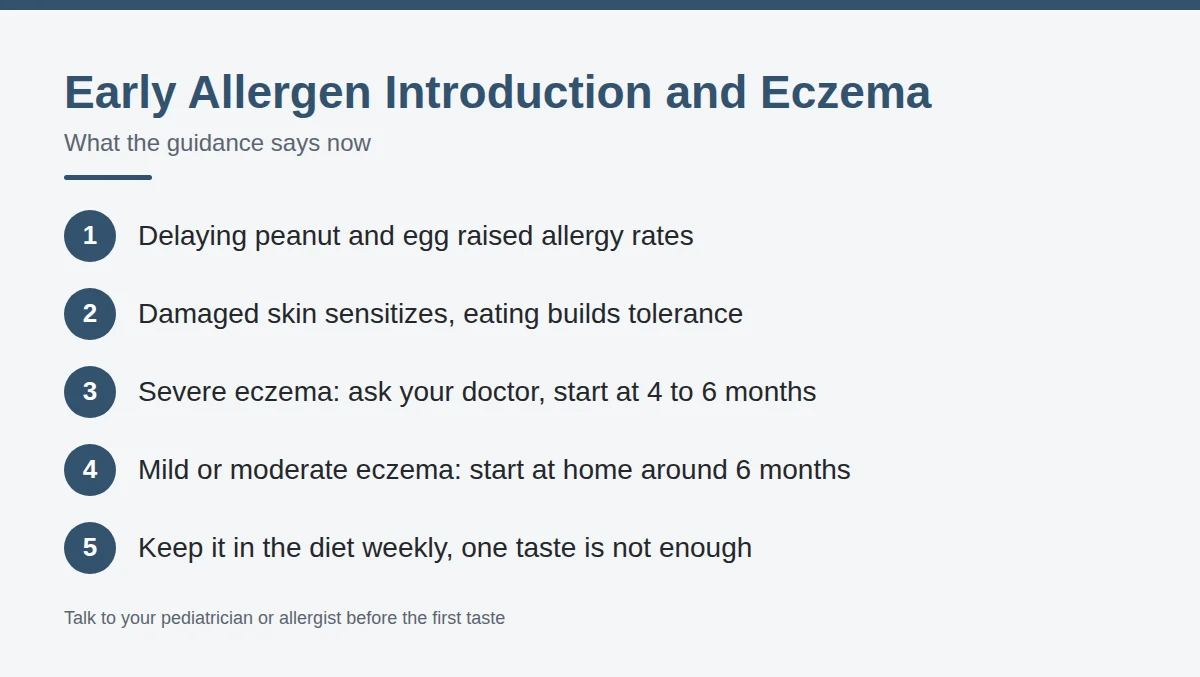
In 2000, the American Academy of Pediatrics advised parents of high-risk infants to delay peanut until age three, egg until two, and cow’s milk until one. It sounded sensible. If a food might cause an allergy, keep it away until the immune system matures.
Then peanut allergy rates roughly tripled in countries that followed the advice. Meanwhile, in populations where infants ate peanut-containing foods from the first year, peanut allergy stayed rare. The AAP quietly withdrew the delay recommendation in 2008, and by 2017 the guidance had flipped completely: allergenic foods should be introduced early, and for the highest-risk babies, deliberately.
Babies with eczema sit right at the front of that highest-risk group, which is exactly why this article is about your child specifically rather than infant feeding in general.
Why eczema puts your baby at the front of the line
Eczema is not a bystander here. It appears to be part of the mechanism.
Healthy skin is a sealed barrier. In atopic dermatitis that barrier leaks, and food proteins floating in household dust (peanut residue on a sofa, egg on a parent’s hands) reach the immune system through inflamed, broken skin. Immune cells meeting a food protein in damaged skin tend to treat it as a threat and build allergic antibodies against it. The same protein meeting the immune system through the gut, by being eaten, tends to teach tolerance instead.
That is the dual-allergen exposure hypothesis, and it produces an uncomfortable conclusion: a baby with eczema can become allergic to a food they have never once eaten. Every month of avoidance is a month of skin exposure without the balancing gut exposure. Delay does not keep the food away from the immune system. It only removes the route that builds tolerance.
The numbers back up the risk. In a longitudinal analysis of more than 218,000 US children, atopic dermatitis peaked in incidence at four months of age and IgE-mediated food allergy at thirteen months, in that order, with peanut (1.9 percent) and egg (0.8 percent) the most commonly diagnosed. Eczema does not just precede food allergy on the calendar. It opens the door. Our guide to the atopic march covers where that progression goes next.
What the trials actually found
Three studies did the heavy lifting.
LEAP (2015) enrolled 640 infants aged 4 to 11 months who had severe eczema, egg allergy, or both, and randomized them to eat peanut regularly or avoid it until age five. Peanut allergy at five years old: 17.2 percent in the avoidance group versus 3.2 percent in the eating group. Among babies who already showed some peanut sensitization on skin testing at enrollment, the gap was 35.3 percent versus 10.6 percent. A follow-up study found the protection held even after a year of stopping peanut at age five.
PETIT (2017) tested egg in Japanese infants with eczema, starting a small amount of heated egg powder at six months alongside aggressive treatment of the eczema itself. The trial was stopped early because the result was so clear: 37.7 percent of the placebo group developed egg allergy versus 8.3 percent of the early-egg group.
EAT (2016) tried introducing six allergenic foods from three months in a general population of breastfed infants. In the group that actually managed to stick with the protocol, allergy rates dropped sharply, but many families could not sustain it. That is the honest lesson from EAT: the strategy works, and the difficulty is in the doing.
When to start depends on your baby’s eczema severity
Guidelines split infants into tiers, and the tier your baby falls into changes both the timing and how much medical input you need first.
Severe eczema, an existing egg allergy, or both. This is the LEAP population and the group with the most to gain. Guidance points to introducing peanut as early as 4 to 6 months, after your baby is developmentally ready for solids, and to involving your pediatrician or an allergist before the first taste. Severe here has a specific meaning: persistent or frequently recurring eczema that needs prescription topical treatment despite good daily skin care.
Mild to moderate eczema. Around six months, at home, with no special evaluation needed. Once your baby is eating a few tolerated first foods, add peanut and egg.
No eczema and no food allergy. Introduce allergenic foods freely with other solids, in whatever order suits your family.
Two boundaries apply to everyone. Do not start solids of any kind before four months, and do not push past six months hoping for a safer moment. There is no evidence that waiting longer protects anyone, and for a baby with eczema the waiting itself carries risk.
Do you need allergy testing first?
This is where guidance has genuinely shifted, and where parents get conflicting answers.
The 2017 US addendum guidelines recommended that infants with severe eczema or egg allergy have peanut-specific IgE blood testing or skin prick testing before their first exposure. Later joint guidance from the allergy societies stepped back from routine pre-testing, because screening healthy babies produces a lot of false positives. A positive test does not confirm allergy, but it frequently leads to indefinite avoidance, which is the outcome we are trying to prevent.
The practical middle ground most allergists work with today: if your baby’s eczema is severe, or they have already reacted to a food, talk to your doctor before the first peanut or egg. Testing may be appropriate, or a supervised first feeding in the office may be a better use of the visit. If the eczema is mild or moderate, testing is generally unnecessary and home introduction is the standard advice. Do not order a broad food panel yourself. Interpreting those results without an allergist causes more harm than the panel prevents.
How to do it at home
Get the skin as calm as you reasonably can first, then follow a simple sequence.

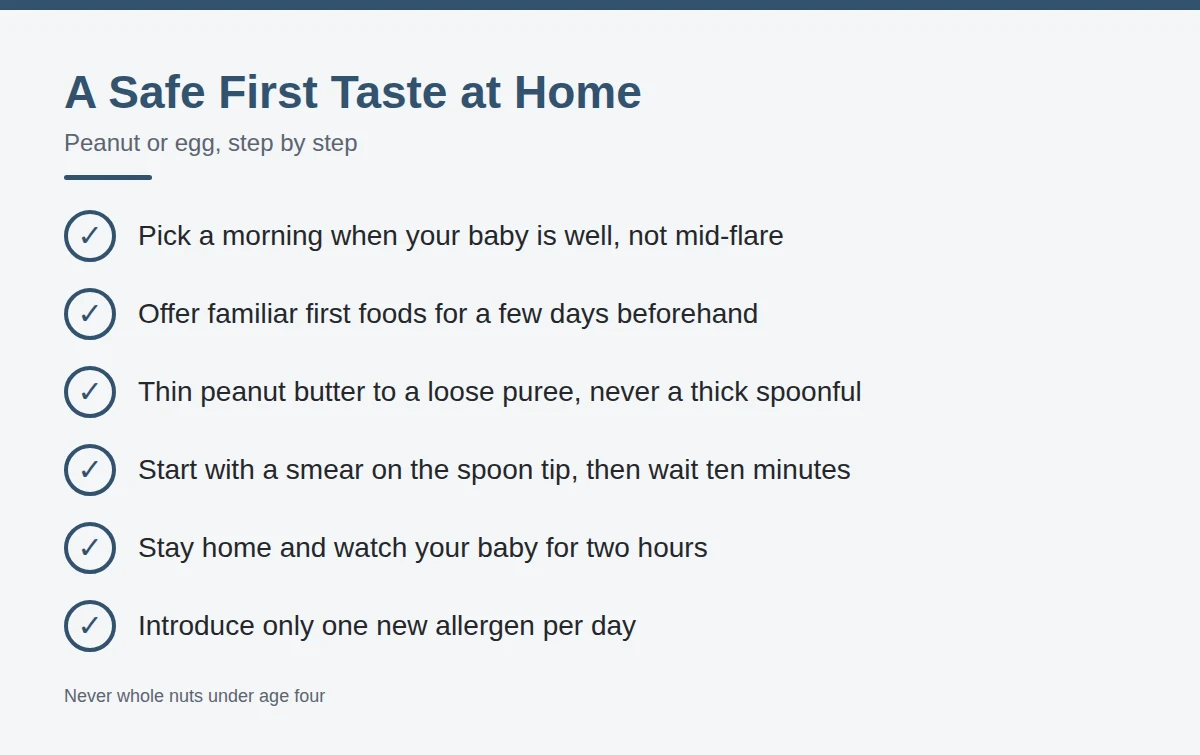
- Pick a good day. Morning, baby well, not mid-flare, not the day of vaccinations, with a couple of unhurried hours ahead and another adult around if possible.
- Establish a base first. Give a few ordinary first foods your baby tolerates for several days before adding an allergen.
- Never whole nuts or a thick spoonful of nut butter. These are choking hazards under age four. Thin two teaspoons of smooth peanut butter with warm water, breast milk, or formula until it is a loose purée, or stir peanut powder into a fruit purée, or soften a peanut puff snack.
- Start with a smear. Offer a small amount on the tip of a spoon, wait about ten minutes, then give the rest gradually if all is well.
- Watch for two hours. Stay home and keep your baby in sight.
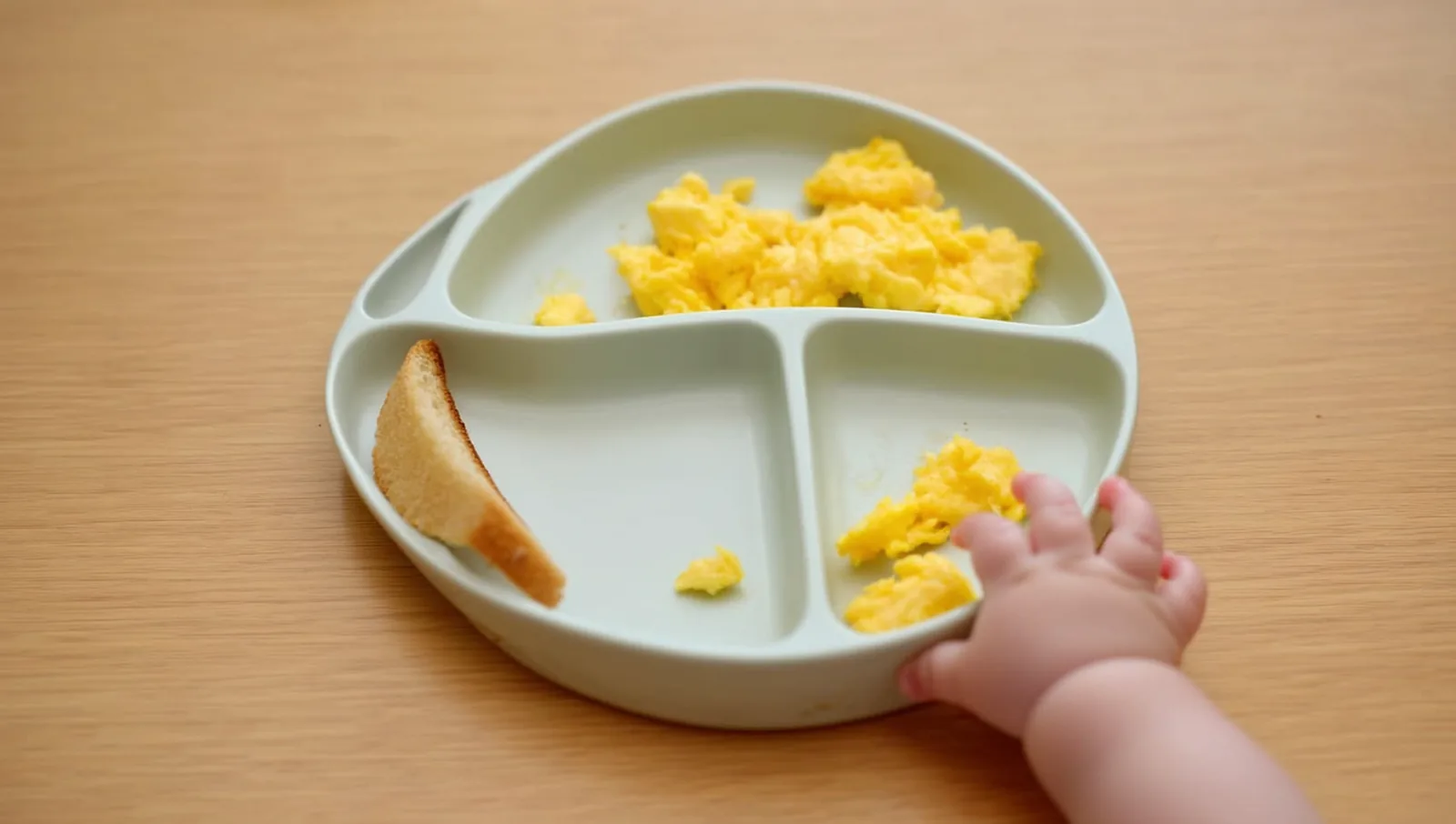
- One new allergen per day. Peanut on one day, egg (well cooked, never runny) on another. That way any reaction has an obvious culprit.
The part everyone skips: keep going
Introduction is not a one-time event. It is the start of a habit.
LEAP infants ate around 6 grams of peanut protein a week, split across three or more meals, and kept it up for years. Roughly a level tablespoon of peanut butter, spread over the week. Egg followed a similar pattern in PETIT. A single taste at six months followed by nothing until the first birthday does not build tolerance, and a food dropped for months can be reacted to on its return.
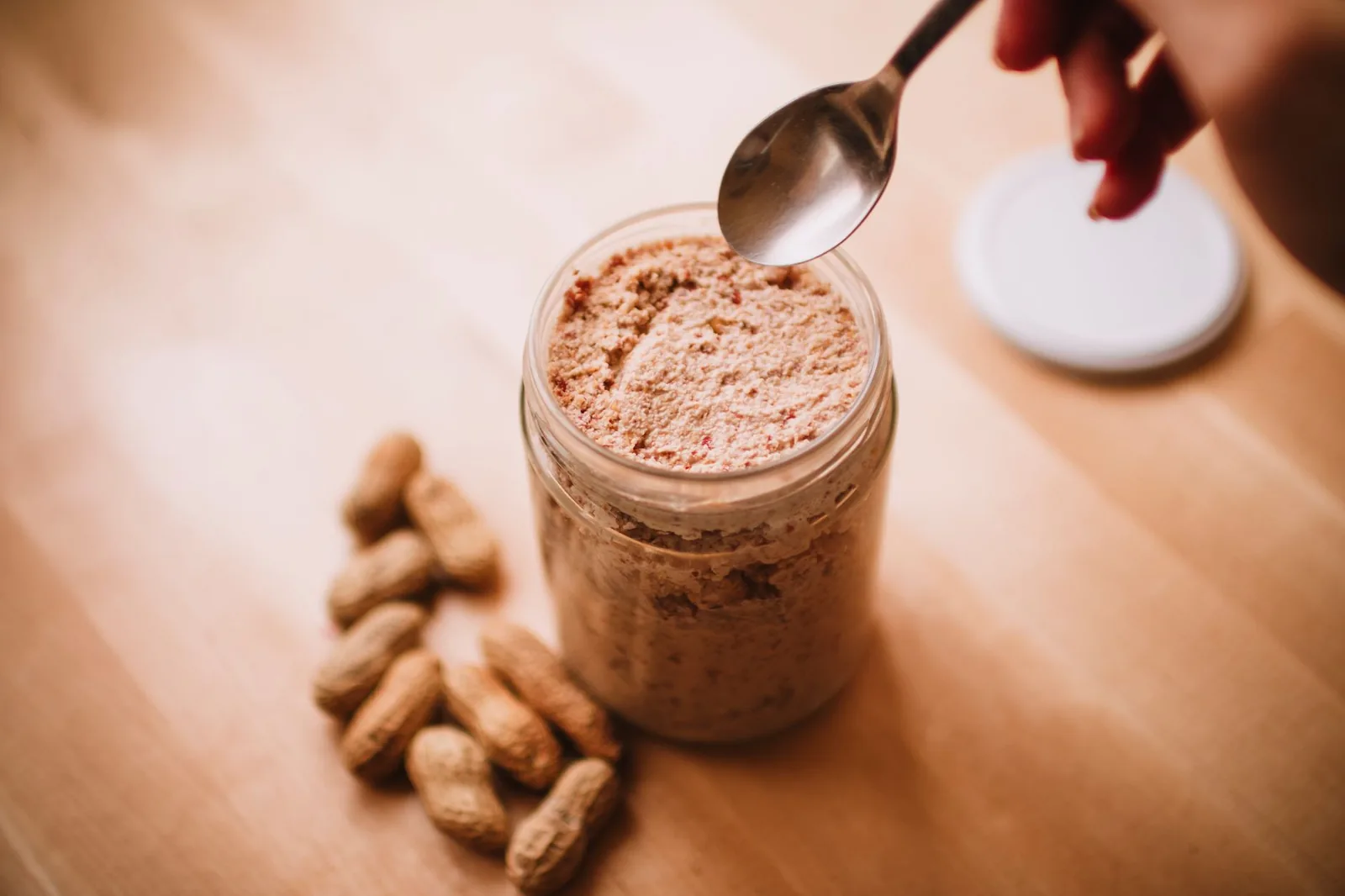
So put these foods on the regular rotation. Peanut in a purée or on toast fingers a few times a week, egg in scrambles, pancakes, or baked goods. Boring consistency is the active ingredient.
What is a reaction, and what is not
True IgE reactions are fast, usually within minutes to two hours: hives, swelling of lips or eyelids, vomiting, coughing or wheezing, or a baby who suddenly goes pale and floppy. Stop feeding and call your doctor for mild symptoms. For breathing difficulty, repeated vomiting, or collapse, use epinephrine if you have it and call emergency services.
Here is the trap for eczema families. Eczema that looks worse the next day is usually not a food allergy. It is far more often the ordinary rhythm of the condition, or friction, heat, or drool. Cutting foods out of a baby’s diet on that basis is common, rarely helpful, and occasionally dangerous, because children have developed genuine anaphylactic allergies to foods they previously tolerated after months of elimination. If you suspect a food is driving the eczema itself, get it assessed rather than acting alone. Our parent’s guide to baby and childhood eczema covers the daily skin routine that resolves most of these flares without touching the diet.
Persistent eczema is also worth treating properly for its own sake, and if it is not responding, our flare playbook walks through escalation steps that are more likely to help than a food diary.
The bottom line
For a baby with eczema, early and sustained allergen introduction is one of the few genuinely preventive tools we have. The evidence is strong for peanut, good for egg, and the direction of travel is consistent: eating these foods early builds tolerance, while avoiding them while eczema-damaged skin meets the same proteins builds allergy.
None of this replaces your own clinician. If your baby’s eczema is severe, or they have already reacted to a food, that conversation should happen before the first taste, not after. Ask at your four-month or six-month visit so you have a plan ready rather than a decision to make on the spot. Every family’s situation is different, and a board-certified allergist or dermatologist can tell you which tier your child falls into and what the safest first step looks like.
Further reading (sources)
- New England Journal of Medicine reporting the LEAP trial of early peanut consumption in high-risk infants
- National Institute of Allergy and Infectious Diseases with the addendum guidelines for preventing peanut allergy
- Cleveland Clinic Consult QD on early eczema care and food introduction as allergy prevention
- The Lancet for the PETIT trial of early egg introduction in infants with eczema
- Pediatrics describing the age and order in which pediatric allergies appear
- American Academy of Pediatrics on the timing of allergenic food introduction
- National Eczema Association covering the link between eczema and food allergy in children